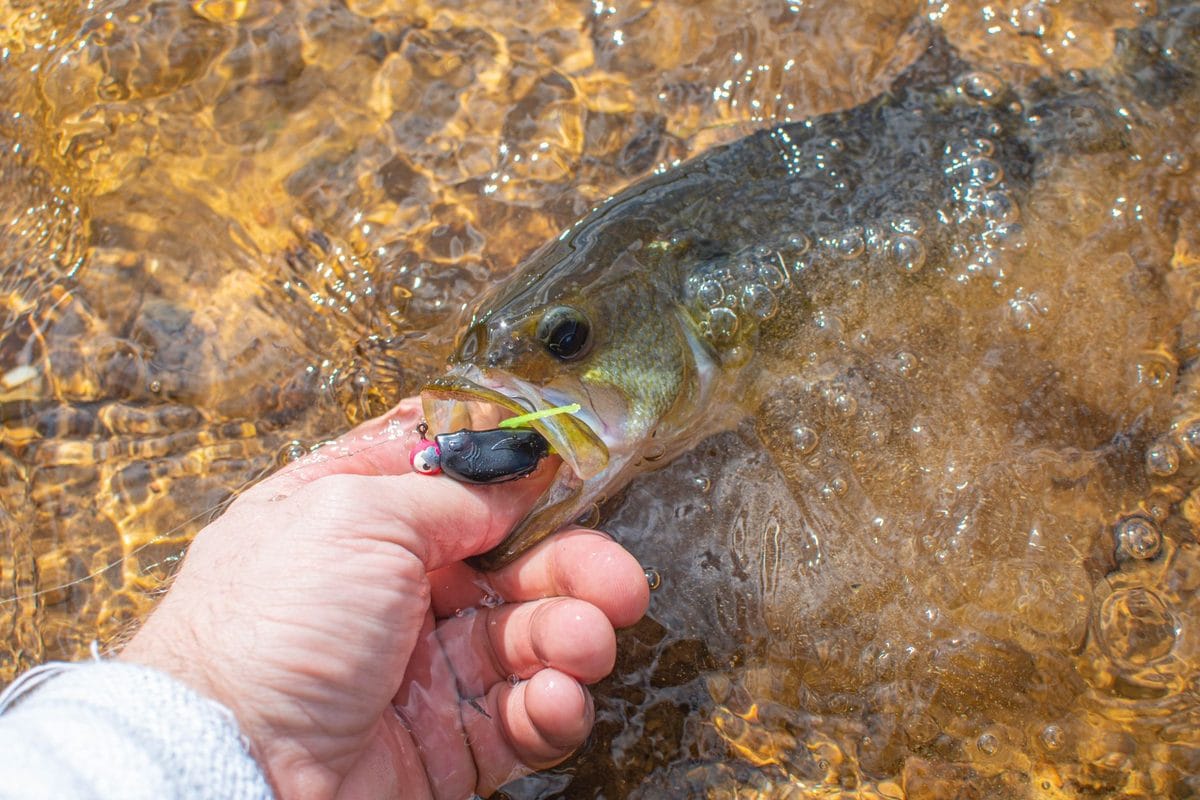
The River Gets Quiet Around the Third Week of July
The fish didn't leave — they just stopped being careless about it.
By late July, the rivers that held aggressive, chasing smallmouth in May have usually dropped a foot or more, and the fish that remain have gone selective in a way that punishes lazy presentations. Water clarity that was tea-brown in spring turns gin-clear once the spring runoff is gone, and a bass sitting in three feet of visible current has had weeks to watch lures splash overhead. Even the boat ramps look different by this point — less current noise, more anglers standing quietly in the shallows rather than idling a motor through them. Anyone who has waded a stretch of the New River near Radford, Virginia in August already knows the feeling: you can see the fish, the fish can see you, and the usual 3/8-ounce spinnerbait that worked in April gets a lazy look and nothing more. A dawn trip that would have produced eight or ten fish back in May might produce two or three by the third week of July, and both of those fish will usually come on the smallest, most natural presentation in the box. The easy months are over and the technical months have started, and the anglers who keep catching fish through August are the ones willing to downsize everything — line, lure, and expectations about how fast a smallmouth should react.
Low, clear water rewards patience in a way spring flooding never does. When the current slows to a crawl and the sun is directly overhead by ten in the morning, a smallmouth's window to feed without exposing itself to a heron or an osprey shrinks to almost nothing, so it feeds in short, careful bursts and then goes back to holding tight against cover. Treat every cast like it might be the only one that fish sees today, because in low water that's often close to true.
Reading What's Left of the Structure
Structure that held fish at four feet of flow often sits high and dry, or nearly dry, once a river drops into late-summer pool. What matters now is current seams around exposed boulders, the downstream edge of gravel bars, and any bit of shade thrown by an overhanging sycamore or a bridge piling. A smallmouth in August wants three things at once: moving water to bring food past without burning energy, shade or depth to escape the worst of the heat, and a clean ambush point within a rod's length of deeper water it can retreat to. Find all three in the same fifteen-foot stretch and you've usually found where the fish are actually sitting, rather than where a map or a spring memory says they should be.
Current seams over flat pools
A slow, uniform pool looks fishy on a hot afternoon, but it rarely produces the way a narrow current seam does — the kind of thin, fast water squeezed between two boulders where oxygen stays higher and baitfish get funnelled through. Work those seams methodically, moving upstream to down, and don't be surprised if the best fish of the day comes from a piece of water no wider than a car.
Downsizing Without Disappearing: Line, Leaders and Lure Weight
Ten-pound fluorocarbon and a 1/4-ounce jig, the combination that produces all spring, becomes a liability once the water clears and slows. Tie on 6-pound Seaguar InvizX instead — it runs about $12 a spool, all but disappears against pale gravel, and still has enough backbone to turn a two-pound smallmouth away from a rock before it wraps you around a branch. Pair it with a spinning rod in the 6'6" to 7-foot range with a fast tip, something like a St. Croix Mojo Bass Spinning at roughly $150, and you get the sensitivity to feel a smallmouth mouth a bait without fully committing, which happens constantly once the water clears and pressure builds.
Lure weight matters more than lure choice in low water. A 1/16-ounce jighead lets a soft-plastic bait fall on a slower, more natural arc, and that slower fall is very often the difference between a follow and a bite. This is the single easiest adjustment most anglers refuse to make — going lighter feels like giving something up, and in August it's the opposite.
Three Rigs Worth Tying On Before You Leave the Truck
None of these are exotic, and dozens of other finesse rigs will also produce on any given day — but these three, tied on in this order, cover most of what low, clear rivers throw at you through August.
- The Ned rig — a Z-Man Finesse ShroomZ jighead paired with a 2.75-inch Finesse TRD, fished on a slow drag along gravel rather than a hop; it's become close to unbeatable on pressured Ozark rivers such as the Meramec and the Gasconade.
- A drop-shot with a 4-inch Roboworm, weight down, bait suspended eight to twelve inches above bottom, held nearly stationary in a current seam.
- Wacky-rigged Senko in green pumpkin, twitched and allowed to fall on slack line next to any visible rock — simple, cheap at around $6 for a pack of five, and it catches fish that have already refused the first two.
What separates anglers catching fish in low water from anglers blanking isn't a secret bait. It's the willingness to slow down and fish something small for twenty minutes in one spot instead of covering water the way you would in spring.
Wading Beats the Kayak When the Water Gets Skinny
A kayak is the right tool on a big river with real flow, but once a river drops to wading depth, the boat itself becomes the problem — the hull pushes a wake, the paddle taps the deck, and a smallmouth in three feet of clear water notices all of it from twenty yards away. Get out and wade wherever the river allows it, even if that means leaving a perfectly good boat beached on a gravel bar for an hour. Moving slowly on foot, staying low against the skyline, and casting upstream so your shadow never crosses the fish first will put more bass in your hand through August than any amount of boat mobility. Felt-soled or rubber-studded wading boots matter here too — a pair of Korkers or Simms wading boots runs $120 to $180, and the grip is worth every dollar on algae-slick gravel. Polarised sunglasses are not optional in this kind of fishing; without them you're casting blind at structure you can't actually see, and a $60 pair of Costa or Wiley X lenses will show you more fish-holding rock in one morning than a season of guessing. Between the boots and the glasses, most of what separates a good wading day from a frustrating one comes down to gear most anglers already own but rarely bother to bring along.
There's a real trade-off here, though: wading limits how much water you can cover in a morning, and on a long float with sparse access points, walking away from the boat for an hour isn't always practical. On rivers with frequent public access — the James in Virginia, stretches of the Susquehanna in Pennsylvania — plan the day around short wades at three or four spots rather than one long drift, and leave the kayak beached rather than anchored mid-current.
Timing the Day Around the Thermometer, Not the Clock
Smallmouth feeding activity in summer tracks water temperature far more closely than it tracks the clock. Once surface temperatures push past 80°F (27°C), which happens by mid-morning on most low, clear rivers in August, feeding slows sharply and doesn't pick back up until the water starts cooling again in early evening. The dawn window — roughly the first two hours of daylight — is usually over by nine, and it's worth being on the water and rigged before first light rather than arriving at a civilised hour and missing it entirely.
This finesse approach holds up in almost every low-water situation smallmouth anglers face in August — except right after a summer thunderstorm pushes a slug of stained, slightly higher water through a river. In that specific window, everything above gets reversed: a Ned rig all but disappears in off-colour water, and a bit of chartreuse and a bladed jig with real vibration will out-fish anything finesse for the twelve or twenty-four hours it takes the river to clear back up.
Handling Fish Responsibly When the Water's Already Stressed
Water in the low 80s Fahrenheit carries meaningfully less dissolved oxygen than the same river carries in May, and a smallmouth that's fought hard on 6-pound line is already working with less margin than it would have two months earlier. Keep fights short by using a rod with real backbone in the butt section rather than an ultralight noodle, land fish quickly rather than playing them to exhaustion, and get any fish you're releasing back into moving, oxygenated water within a few seconds rather than posing for three photos first. Most state wildlife agencies now publish specific guidance on catch-and-release best practice for warm-water conditions, and it's worth a five-minute read before the season gets away from you.
None of this is complicated, and none of it requires new gear beyond a spool of light fluorocarbon and a handful of $2 jigheads. What it requires is patience, and a willingness to fish water you'd normally walk past on the way to somewhere that looks better.