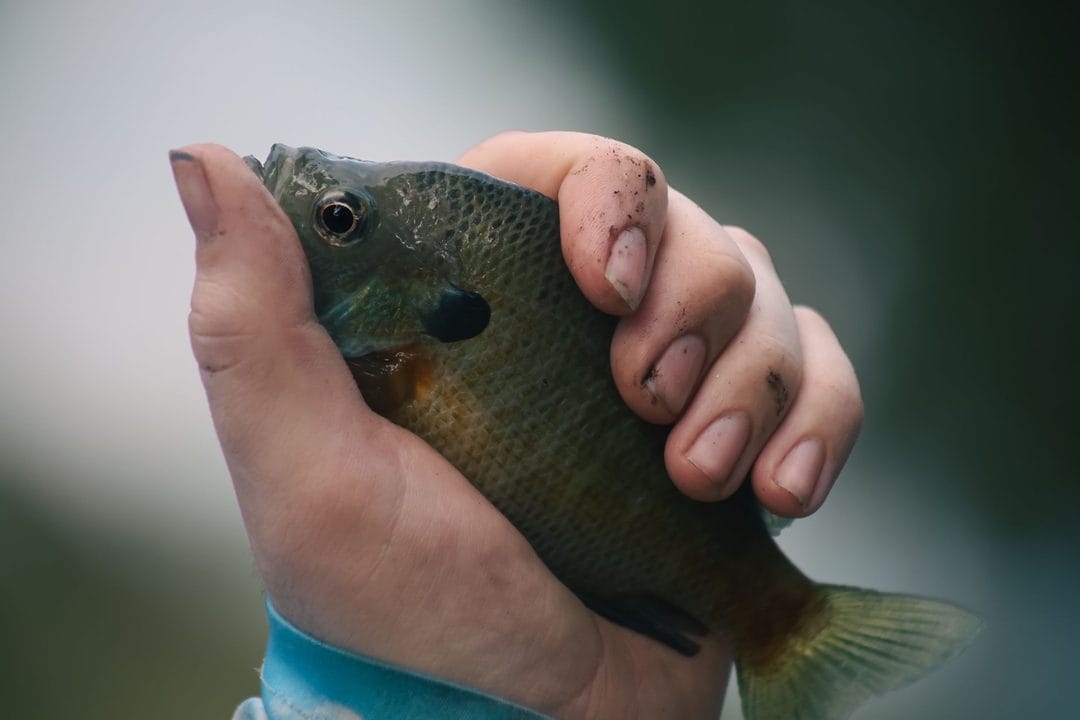
Every June a familiar thing happens on lakes and farm ponds across the country: the bass guys are grinding deep with crankbaits and electronics, the catfish crowd is out after dark, and almost nobody is fishing the most willing, most accessible, and frankly most fun bite of the entire summer. Bluegill move up to spawn in shallow water through June, they bite all day, and a kid with a $40 fly rod can outfish a bass boat for sheer numbers. If you've got a son or daughter you want to actually hook on fishing — or you just forgot how good it feels to catch fish every few minutes — this is the month and the bluegill bed is the spot.
Finding the beds
Bluegill spawn in colonies, and the beds are easy to spot once you know the look: clusters of lighter, dinner-plate-sized circles fanned out on the bottom in two to five feet of water, usually on a firm sand or gravel flat near cover. Find one bed and you've usually found twenty. They favor protected pockets — the back of a cove, the inside of a point, anywhere the wind isn't pounding. Polarized glasses turn an invisible bottom into an obvious honeycomb of nests, and on a calm morning you can sight-fish the whole thing.
The bull bluegills — the deep, dark, hand-sized ones worth catching — guard those beds aggressively. That's the whole reason the bite is so good. They're not feeding so much as defending territory, and they'll hammer anything that drifts over the nest.
The gear, kept honest
You do not need to spend money here, and that's the point. Two setups both work:
- A simple spinning rod with light line, a small bobber, a #8 hook, and a piece of nightcrawler or a cricket. This is how most of us learned, and it still outproduces almost everything.
- A 3- or 4-weight fly rod with a small popping bug or a foam spider. This is the one that turns a routine afternoon into something you'll remember — a bluegill on a fly rod fights like a fish three times its size, turning sideways and pulling drag.
If you go the fly route, a cheap combo from Echo or the Orvis Clearwater outfit (around $250 ready to fish) is plenty. You're casting twenty feet to fish you can see. This is not a place for technical gear snobbery.
Why the popping bug is worth learning
A small rubber-legged popper twitched over a bed gets crushed in a way that's genuinely addictive. Cast past the nest, let it sit until the rings settle, then give it the smallest twitch — not a chug, just enough to wobble the legs. The take is instant and visual. This is the most reliable topwater fishing in North America, more dependable than any bass blowup, and it happens in water you could wade in shorts.
The catch worth mentioning: those big bull bluegills are the breeders, and a colony can be cleaned out fast. Keep a mess of the medium ones for the fryer if you want — bluegill are outstanding eating — but put the biggest ones back. They're the genetics that make next year's beds worth fishing.
Best window and a few real spots
The spawn peaks around the full moon, and June's full moon makes the back half of the month prime across most of the country. Morning and the last two hours of light are best on bright days, though on overcast days they'll bite straight through noon.
You don't need a famous destination for this. A neighborhood pond, the local reservoir, a slow stretch of creek with a gravel bottom — bluegill are in nearly every body of warm freshwater in the lower 48. State park lakes are loaded with them and almost nobody targets them. If you want a genuine trophy, the panfish factories of the upper Midwest and the southern reservoirs grow gills past a pound, and a one-pound bluegill is a legitimately rare fish that most lifelong anglers never land.
The real reason to do this
There's a version of fishing that's about electronics, tournament weights, and $80,000 boats, and there's a version that's a kid in flip-flops catching a fish every cast and not wanting to leave. June bluegill is the second one. It costs almost nothing, it works almost everywhere, and it's the surest way to turn somebody into a fisherman for life.
Bring a kid, a coffee can of worms, and a couple hours of daylight. The fish will handle the rest.